Burkina Faso Itinerary
 |
|
|
|
 |
 |
 |
|
 |
 |
 |
|
 |
 |
 |
|
 |
|||
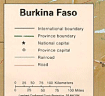
Location in Central West Africa
Population 12.6 million; approx. 40 inhabitants/km²
Life expectancy 45.9 years
Area comparative approx. the size
of former West Germany or slightly larger than Colorado
Border countries to the north-west Mali, to the north-east Niger, to the south-east Benin, and to the south Togo, Ghana, Cote d' Ivoire
Burkina Faso is a country of hospitality and tradition, a place to slow down, step down a gear and unwind
Planned arrival January 2004
Burkina Faso – Cultural darling of West Africa
We cannot phrase it better than the Lonely Planet which says that Burkina Faso’s inhabitants ‘come from one of the poorest countries in the world, but are principally known for their don’t-worry-be-happy philosophy and reputation for hospitality; they have very few natural resources, but have managed to fashion a beautiful and culturally sophisticated country out of the little that they do have.’ This perfectly characterises the people we met in Burkina Faso, one of West Africa’s landlocked countries and in contrast with its neighbour Mali not blessed with any major tourist attractions. The latter has probably also helped to preserve the Burkinabes’ genuine friendliness. One occurrence probably characterises best how friendly these people are: One day in Dedougou we were determined to make fresh orange juice. Hence, we searched the town for a juice squeezer, without any success. Most retailers told us that they knew what we were talking about but that they were out of stock. However, everybody was so friendly to show us another shop which might still have one. None of them did have one. After a while we gave up and walked towards the hospital to meet Harald. Three guys who were sitting behind a truck enjoying a cup of tea realised that we were not happy. They greeted us friendly and asked whether we were searching for anything. We told them our story, were invited to sit down and one of them jumped on his moped in order to resume the search. We had a very nice conversation with the other two while waiting. Christian walked off after a while and Anja had interesting discussions about how many children a couple should strive for. When the third guy returned, he must have cruised most of the town and was utterly sorry that he had only found a used juice squeezer whose owner was unwilling to sell. In order to make up for the dommage, he offered Anja a ride on the back of his moped to the hospital. The gate-man at the hospital was quite astonished when he saw that carriage...
City life in Ouagadougou, Burkina Faso’s capital
Our first night in Ouagadougou was not so promising, squashed between a squeaky toilet door and the room of a screaming mentally disabled man, we found little sleep in our tent. Thanks to Nuria, a Spanish stagiaire at the German Development Service, we were able to move out the next morning and into the ded’s guesthouse. Strictly speaking, it is explicitly stated that tourists are not allowed to stay there but we were visiting the stagiaire...
Ouagadougou surprised us as a real city. Multi-storey buildings, tarred streets, big stylish advertisement boards, well-stocked supermarkets, functioning internet cafes on every corner etc. Progress seems to determine people’s lives: In order to make room for new buildings, a whole quarter has been demolished in the town centre. No doubt that there are many poor people in Burkina Faso but we also got the impression that the Burkinabe are very good at forging the official statistics correctly in order to remain one of the world’s poorest countries.
By the way, Ouagadougou is also an excellent place to celebrate New Year’s Eve. We dined at a French/Italian restaurant and tickled our taste buds with delicious cuisine. The women’s dresses were spectacularly beautiful and colourful , the city was nicely decorated and one only had to be careful around twelve o’clock to jump faster than the nearest exploding firecracker.
Non-tourist sites – Kongoussi and Dedougou
Hanita and Wilfrid, two Dutch who work for the ded were so nice to invite us out to Kongoussi, about 130 km north of Ouagadougou, where they are based. There, far away from any other tourists, we managed to write our Mali update, learned how to make yoghurt, consumed freshly grilled chicken, understood anti-erosion farming techniques, discovered where the inventor of the step fitness apparatus stole the idea from (water pumps that function by stepping) and for half an hour visited a house perfectly placed at the tip of a peninsula, no spectators except for the odd fishing pirogue, the terrace, surrounded by blooming bushes and trees, being the jumping board into the lake – Burkina style colonialism.
From Kongoussi we hurried on to Dedougou in order to reach Harald, Assistant Technique de ded in Dedougou’s regional hospital, in time to witness the Paris-Dakar rallye drive past. Unfortunately, security problems up in Mali made the rallye organisers cancel this stage at short notice (or was the real reason that too many vehicles had already dropped out of the race and the organisers wanted to ensure that some cars, motorcycles and trucks reached Dakar after all?). Therefore, we missed the extra portion of sand in our faces and clothes and went on a hippo expedition instead. Harald dared to jump into a pirogue in order to shorten the distance between the hippo family and us and get a better glimpse of the beasts. The rest of the party was not so adventurous and was satisfied with the sight of splashing water and a bit of skin somewhere in the distance.
All later very much enjoyed the less dangerous activity of watching local fishermen skilfully throwing out their nets at a nearby dam.
The three of us picnicked for lunch and both Christian and Harald practised hard to master a stone catapult just as well as Harald’s guard who surprised us with a dead cat one evening. Fortunately, they still lack the skill to hit a big tin over a few meters... For now, Harald’s chicken and cock will have to remain under his guard’s surveillance.
The green South
A few days later another nerve racking bus ride brought us south to Bobo-Dioulasso, Burkina Faso’s second biggest town. Here, we were back in the tracks of those tourists who cross Africa with their own vehicles and were lucky to locate two who offered to take us along in their camping vehicle to Banfora and Gaoua in Burkina Faso’s Southwest. By then we had become bissap addicts. Bissap is a drink made of dried hibiscus flowers. The flowers are boiled in water as to make tea, loads of sugar are added, the cooled fluid is then filled into small clear plastic bags and put into the freezer. Sipping a bissap at 35 degrees Celsius is a very refreshing experience! Thereafter, whenever we hit a town with electricity, we immediately started to search for bissap.
The culture of the Lobi people dominates the area between Banfora and Gaoua. Their one-storey mud brick houses resemble small fortresses: single room buildings are set against an outside wall that surrounds a central courtyard. Grain is stored on the flat roofs and in round shaped granaries with conical grass roofs that resemble peaked caps. The granaries are rested on wooden branches that themselves lie on some big rocks. This structure seems to protect the grain from water during the rainy season and from undesired animals. The Lobi women produce some nice pottery and baskets made from grass that are square on the bottom and round around the top. As in Mali’s Dogon country, drinking Dolo, beer made from millet, out of dried and halved calebasses is a popular pastime in this area.
The big camper was not the fastest vehicle we had ever sat in. But this way we could take some photos while riding along, finish reading a book and admire the lush green forest that grows in Burkina’s Southwest and the big white cotton piles that the villagers jump around in. We reached Gaoua when nightfall had already set in and treated ourselves to a rather expensive hotel room with hot shower. As our only expenditure that day had been four bissaps for about EUR 0.30, we felt like being generous to ourselves.
Harald from Dedougou helped us move out of the expensive place the next day and we were very happy to be offered to move into Alexandra’s guestroom. She is working on a study for the GTZ, Gesellschaft fuer Technische Zusammenarbeit, in Gaoua. We were thankful to have a roof over our heads and worked on our laundry for the rest of the day.
Alexandra has many nice Lobi baskets in her house and we thought that they would make for a nice present. Hence, we set out to buy some. That was easier thought than done, as this was a commodity only to be bought on Sunday’s market – it was Tuesday – and some tourist had bought up all of the museum shop’s basket supply that day. After a morning’s search, our gain was only one basket but we had trotted along most of Gaoua’s streets.
The afternoon surprised us with a sudden downpour that did not loose its power for a few hours. A little bit strange during the dry season but this way we got a glimpse of what the rainy season must be like.
Backtracking our steps to Bamako
Up to now, we had been very good at resisting all souvenir sellers. With just a week to go in Africa the feeling arose that we could and should buy something. The something became more and more during two days in Bobo-Dioulasso until Christian’s backpack was mainly filled with souvenirs and was a bit heavier than it had been.
Once off the beaten tourist track in Sikasso in Mali’s South, we were surprised to be left alone and greeted with a genuine friendliness. What a difference to all of the other places we had visited in Mali! After all, tourists who show their wealth openly or hand out sweets and pens just like that do seem to change people’s attitudes and the state of their teeth.
A torn tire prolonged our last African bus trip from Sikasso to Bamako by about three hours. Nevertheless, we had been extremely lucky as it was one of the four back tires, the bus was still manoeuvrable and we had just reached a town. Many bissaps later we were back on the road with a new tire and experienced no further difficulties reaching Bamako.