Tanzania Itinerary
 |
 |
 |
 |
 |
 |
 |
 |
 |
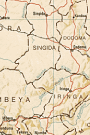
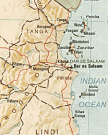
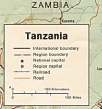
Location in East Africa bordering the Indian Ocean
Population about 37 million; approx. 35 inhabitants/km²
Life expectancy 46.1 years
Area comparative slightly smaller
than 3 times the size of Germany or slightly larger than twice the size
of California
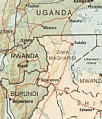
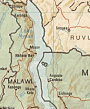
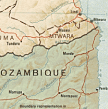
Border countries to the north Uganda and Kenya, to the west Rwanda, Burundi and Congo, and to the south Zambia, Malawi and Mozambique
Tanzania's elevation extremes lowest
point is the Indian Ocean 0 m
and the highest point Mount Kilimanjaro 5,895 m
Planned arrival July 2003
October 31, Tanzania at its best!
Tanzania greeted us as pleasantly as it had in July, we promptly received a transit visa which was cheaper than what we had expected, a friendly manager from BP gave us a ride to our hotel and the warm sun completed a perfect welcome. We immediately noticed again how friendly and cheerful the people are. We had missed that in South Africa and Namibia. Despite being poor, everybody seems to wear a smile on his/her face. Smiling we enjoyed our 48 hour stopover, pacing the city’s dusty streets and sidewalks with all their smells, colours and sounds, haggling about prices and noticing that several coffee bars and bakeries as well as a stylish new shopping centre with Woolworth and South African chain food restaurants had opened up within the last four months. A special highlight for us was being present for the movie ‘Nowhere in Africa’ shown as part of Dar es Salaam’s European Film Festival at the British Council in the original German/Swahili/English version with English subtitles. This was the perfect place and the right audience to view this movie with!
05 September, Malawi’s island in the sky - Mount Moulanje
Arriving in Mulanje village a group of porters tried to cheat us by not obeying to the rules of the local forestry office. We found out just in time to change porters and make our way up Mount Mulanje after learning how to separate rice corns from the chaff by pounding. The three hour ascent was rather tough for us and we were just astonished by how the skinny porters managed it with our backpacks… Once we reached the plateau at 1850 metres NN we were spoiled with splendid views of the surrounding peaks and the countryside down where we had set off.
Once darkness fell over the hut where we slept the first night, a nice fire kept us warm and made us fall asleep. Not for long however, as the pine burned down quickly and the permanent inhabitants took over the premises: plenty of fat rats. How do we know? Because one of them decided to walk over Christian’s hand waking him up… From then on we only slept in two hour intervals to keep the fire going. Much to our amusement, the well-rested French couple asked us at breakfast whether we had heard the mice during the night.
The morning was again beautiful and we understood why Mount Mulanje is called the island in the sky: clear blue sky above our heads with all of the peaks and the plateau visible but the lower surroundings were covered under a thick layer of clouds. Simply superb!
The second evening Christian had to try the porters’ food and that turned out to be not the smartest idea he’d ever had. It was in the middle of the night when his stomach decided to get rid off what he had stuffed it with. Unfortunately, a hut up in the mountains without electricity and with ‘exterior toilet’ during a freezing (yes, frost!) cold night was not the ideal place to get sick. Us being tired-out from the night before and the stuffed chimney of the fireplace which was blowing all of the smoke inside the hut did not improve the situation… This has been our worst night so far.
Luckily, Christian managed to make it down the mountain on the rather sporty and in parts dangerously steep path by sucking on dextrose. We arrived just in time to catch a minibus back to Blantyre where Anja enjoyed lunch ;) before we headed on to Lilongwe.
24 July, Goodbye Tanzania, Welcome Malawi
Arriving at Amani Centre, Morogoro
We immediately noticed the peacefulness (Amani = peace) at Amani Centre.
As always when getting out of a taxi, we tried to quickly grab our bags
but the youth trying to do the same replied “it is ok, you are now at
Amani Centre, no worries.” Despite the fact that the centre is located
in one of the slum suburbs of Morogoro, we felt extremely safe during
the four days/nights that we stayed there.
Motivated by the hardships she faced in the late eighties/early nineties bringing up her own disabled child, Mama Bakhita managed to mobilise fellow parents with mentally disabled children thereby founding Amani Centre in 1992. Since then, their goal has been to provide health care and education services to children with mental disabilities and to carry out community based rehabilitation through home visits and counselling. Thus, the Centre helped to raise public awareness for the rights and needs of disabled children. Up to now, 1.300 children have benefited from the Centre’s programmes, buildings have been constructed for training sessions and offices and farming grounds have been bought in order to offer both an income and jobs for older disabled persons.
We were quite impressed by what Mama Bakhita has put in place for the last thirteen years by mobilising communities and non-governmental organisations. Besides living at the Centre in Morogoro, we also got to see the farm and the grounds of the future training centre for community workers about 75km north of Morogoro. The original plan was to further visit two families of disabled children together with community workers. A funeral of an important servant who had worked in the secretariat of the ruling party distracted the plan. As one of the village’s influentials it was inappropriate for Mama Bakhita to do something else whilst a funeral took place. Hence, she attended the funeral and we had a short picnic with some youth. After this the youth went to quickly pick up Mama Bakhita and we were asked to wait at her auntie’s banda being entertained with lunch. Two hours later the others got back and we had learned another lesson of hakuna matata.
Back at the training centre we got to see another one of the projects, which Mama Bakhita has initiated: a day care centre for elders. Arriving there we were warmly greeted with cheerful singing by the group of elders. Under a large tree a ceremony awaited us. We were seated in the middle of a row of chairs, the chairman of the group to our left, Mama Bakhita and the group’s secretary to our right. In front of us we had an altar-like bench on it a box and a visitors’ book. The rest of the people gathered in a half circle around us. The master of ceremony welcomed us and introduced us to the day care centre for elders and the group’s activities. Thereafter we introduced ourselves, Mama Bakhita translating. The group meets twice per week exchanging their views, discussing their problems and helping each other in times of need. A person has to turn 60 before he/she is regarded as elderly and can join the group. During the ceremony, Mama Bakhita handed over crutches that had been presented to a community worker who attended a workshop in Norway and three bags of clothes donated by an Asian women’s group in Morogoro. According to Mama Bakhita’s translation it is a custom within the group to make donations in the cardboard box in order to pay for next Saturday’s breakfast and lunch. The donation giving process was accompanied by singing. Thereafter, the box was opened and the money ceremonially counted and recounted aloud after everybody who wanted to (or was supposed to?) had donated. We shook a lot of hands before returning to Morogoro. Yet before reaching Amani Centre, we experienced our first African car breakdown. Actually a very unspectacular overheated engine…
We spent one day hiking in the Uluguru Mountains, which surround Morogoro. A steep path, which must be extremely difficult to climb during the rainy season lead us up to Morningside, a former German weekend retreat built in 1911. On the way up we met many women carrying heavy baskets filled with crops from their fields on their heads down to the market in Morogoro. On the way down we met many more now returning from town with sugar, flour and wood. We sweated much, especially on the way up, and had a hard time imagining that some people walked/climbed this as a daily routine. From Morningside, which still looks remarkably intact after so many years, we had a nice view over Morogoro and the Uluguru Mountains although often distracted by clouds.
From Morogoro to Mbeya
Although the German government and others have again released a security
warning for Tanzania, we are not scared of terrorist attacks. The bus
rides, however, can be quite terrifying at times. Despite the fact that
we have chosen to travel with the safest company with the newest vehicles
and most sane drivers (according to our guidebook) safety is not really
an issue but getting to a place as fast as possible is. Therefore, on
what we would regard as a scenic route through mountainous terrain (In
this particular case the TANZAM highway crossing through the Udzungwa
Mountains in southern Tanzania.), bus drivers try everything to go at
full speed. Fortunately, we have only seen one capsized bus so far and
we will try to keep it that way.
An eight hour bus ride brought us to Mbeya where we were again welcomed by many touts trying to get us into the place that pays the highest commission to them or to sell bus tickets to us. One of them stuck to our little group of three wazungu (foreigners), Frank, a Dutch chap, also heading down to Johannesburg but with a few more days to spend before he has to catch a flight home and the two of us. The first three guest houses were full, the fourth didn’t have any mosquito nets and the ceilings were too high to put up our own, the fifth was full and by that time we were so desperate to find a place as we had been walking with our backpacks on through the dark streets of Mbeya even being greeted with “Welcome, HIV” that we accepted rooms in the Mbeya Peak Hotel, a rather expensive option. It was especially amusing that our tout repeatedly uttered that he was accompanying us because he didn’t want wazungu to suffer…
The hot shower with full water pressure as well as the good mattress made us happy again. The dinner around the corner for one twelfth of the room price also eased the financial burden.
First African border crossing on foot
Monday turned out to be the daladala day. Starting in Mbeya we hopped
on to one that brought us to the Tanzanian-Malawian border where we gladly
stretched our legs walking from one border post to the other. The paperwork
was no problem at all and we happily received a few more stamps in our
passports. The border itself is the river Songea where people were washing
their clothes on both sides. No guards, weapons or anything in sight.
Just when we passed the final fencing, a minibus was about to turn and
leave for Karonga. Squeezing in with five more wazungu and several other
passengers, we jetted along excellent Malawian roads the only break being
the change over to another minibus taking us on to Mzuzu. As most of us
wazungu lacked Malawian Kwacha, a plan was made to quickly stop at a local
bank and then head on. The minibus driver will never repeat this offer
as two Dutch girls as well as two Italians tried to get money on their
Visa cards. Concerning this undertaking, Frank’s guidebook suggests to
drop your credit card early in the morning and pick up the money late
in the afternoon. We had plenty of time to enjoy the roadside barbeque,
excellent grilled bananas and spicy (!) nyama choma and get to know the
other Tanzanian/Malawian passengers. Hakuna matata!
The rest of the bus ride to Mzuzu went smoothly although our legs are just too long for these Toyota Hiaces. Everything hurt when we finally reached Mzuzu around 5 pm only to board another minibus right away to Nkhata Bay at Lake Malawi. The free tout-pickup service to Mayoka Village where we wanted to stay anyway came in handy after covering about 600km in crowded minibuses ;) This hippie establishment with a Caribbean feel provided us with a bungalow/hut including lake view from our bed and plenty of pasta/fish for dinner. Anyone interested in cheap diving courses (open water for around $150) this is your place. We were a bit too afraid of bilharzia that does exist in Lake Malawi although the locals were saying that this part of the lake is not affected. After a relaxing full day of lazing around, doing our laundry and canoeing in dugout boats watching the Mozambican mountain ranges in the distance and pretty fish beneath us, we again boarded minibuses via Mzuzu to Lilongwe. So far, the ride from Mzuzu to Lilongwe has been the most painful by far: 20 people and luggage cramped in four rows behind the driver. It is amazing what joints, muscles and flesh can take!
Lilongwe and then
From what we have seen and read so far about Malawi, the choice of goods
on markets is more limited and people’s clothing is less colourful and
less varied compared with Tanzania. The country is obviously poorer. This
is also reflected in the country’s capital where the city centre doesn’t
really feel like one and where we were advised to stay out of certain
areas even during daytime. We tried to take in that advice and after eating
dinner in town yesterday evening, we asked the restaurant staff to organise
a cab for us. A chap had presented himself to us as the organiser of the
cab asking for 50 kwachas for the provided service. He immediately purchased
a cone of soft-ice from around the corner… The first car that showed up
turned out to be a private vehicle with a flat battery and thus couldn’t
restart. The second ‘cab’ driver tripled the price and wanted his friend
to come along. After some negotiations and waiting around, we boarded
that car without his friend for double the original price. On the way
we discovered that the car didn’t feature headlights nor did the driver
know where he was going. Arriving at the guesthouse, he was probably more
scared of us than we were of him. Nonetheless, the Malawian people seem
to be very open to foreigners and children get less excited about the
wazungu.
From here we will head on to Mount Mulanje in the south of Malawi for some hiking only to return to Lilongwe next Monday to catch a flight down to Jo’burg. More minibuses!
15 July, back from Zanzibar and Serengeti
We didn’t manage to write the promised update on Zanzibar
as we fled Stone Town after one night. Architecturally, Zanzibar’s main
town was once very pretty but its former grandeur is slowly rotting away.
Central Stone Town with its labyrinth of narrow streets and alleyways,
markets at the waterfront and many mosques could be a very atmospheric
place. However, too many tourists have spoilt it. With a white face, one
cannot take five steps without a flycatcher, so called papasi, talking
to you trying to sell something. That is how many young guys make a living
but for us their persistence was intimidating and nerve racking. There
is no way to get rid of them. We decided the same evening to leave Stone
Town early the next morning and head for a small village on the East coast.
Getting to Pwani Mchangani was another experience: We caught the right daladala, a small pickup (Toyota Hiace) with a roofed bed and benches along three sides. Apparently, up to 20 passengers are allowed but in reality a daladala can cope with at least 25 plus baggage.
A four-kilometre walk along a dream beach strengthened the muscles of our backs as we carried our gear. The guest house which we had chosen from our travel guide was full. Some long discussions started between our self-appointed guide and the villagers while the sky opened up and we experienced our first tropical downpour.
They decided to accommodate us in another guest house in the village where no white foreigners had ever stayed before. A simplistic room with a double bed became our home for three nights. It was the girls’ task to carry buckets of water from the nearby well for us to use for drinking, washing and doing laundry. The Mama Nyumbani, mother of the guest house, provided us with three excellent Tanzanian meals per day. The few Swahili pages in our guide book were essential for communicating. We also learned that watching Disney movies can be very educating as Lion King had already taught us the Swahili words for friend (rafiki) and lion (simba). The village’s children took the opportunity of having a foreigner living in their neighbourhood and really checked us out. The animal pictures in the Rough Guide and our ability to whistle on pieces of grass ensured that the next two days didn’t get boring. The digital camera was another attraction. Besides communicating with the children, we practised mwani (seaweed) harvesting and walked out towards the coral reef at low tide. One morning we went out with two local fishermen on their self-made boat but none of the fishing rods caught anything. Nevertheless, sailing across and beyond the coral shelter was fun and we did see some big fish. Finally, we watched our food being prepared and later being cooked on a three-stone fireplace.
We left the village on a luxurious minibus that turned out to be cheaper than the daladala and took the next ferry to Dar es Salaam. It was the 7th of July, Saba Saba Day in Tanzania, a national holiday. The markets were open but most of the shops were closed. Hence, we couldn’t change any Travellers’ Cheques nor write a new update for the website. Instead, we bought bus tickets to Arusha and walked through the African, Asian and formerly colonial quarters of Dar es Salaam. We also started to practice our bargaining skills buying fruits and veggies on the lively markets.
A ten-hour bus ride brought us from Dar es Salaam to Arusha, the highlight being glimpses of Mount Kilimanjaro which was mainly covered in clouds. We arrived late in Arusha, however, managed to arrange for a safari starting the following day. The safari first took us to Lake Manyara National Park, where we spotted many elephants and giraffes and saw large numbers of flamingos and pelicans from a distance. A ride on a bumpy dirt road took us from Lake Manyara through Ngorongoro Conservation Area to the Serengeti plains. The changes in landscape were amazing from rolling hills with farm land to the rainforest covered heights of the Ngorongoro Crater rim, from the deep cuts and high escarpments of the Great Rift Valley to the wide open grassy savannah and acacia forests of the Serengeti. Inhabitants changed with the landscape from settled farmers in brick houses to cattle-herding Maasai in round bomas perfectly blending in with the surroundings, from baboons and many colourful birds in the rainforest to gazelles, antelopes, warthogs, hyenas and bigger game in Serengeti.
For five days we enjoyed the sighting of the big five and numerous other animals as well as the small but nonetheless impressive part of the annual migration of 1.7 million wildebeest and closed to a million other animals in Serengeti. We stayed over night in campsites and were very well fed by the cook whilst we were still getting used to the hole-in-the-ground sanitation. The big temperature changes forced us to use a lot of sunscreen lotion during the day and put on all of our clothes during the night to stay warm.
The last evening was especially memorable as we convinced Maluta, our guide, and Habib, the cook, to have a beer at the local village of Nanokanoka in the Crater Highlands. There we sat in a small wooden shack on stools in the local supermarket cramped in between sacks of rice and maize flour and boards packed with cooking oil, kerosene, razor blades, toothbrushes, toilet paper, Maasai blankets and much more, drinking cold Kilimanjaro beer.
The next morning we eventually sighted two of the few remaining black rhinos before returning to Arusha in the afternoon. And here we are now, enjoying a “day off”, doing laundry, buying a new roll of toilet paper, taking the first shower in five days and writing this update. By now we could have bought so many pictures, paintings, t-shirts and carvings as loads of young man are willing to offer their best pieces for a very(!) good price just to us and only to us...
We will rise early again tomorrow morning in order to catch a bus at 6 am to Morogoro in central Tanzania where we plan to trek the Uluguru mountains for a few days and visit Mama Bakhita. From there we will head on to Mbeya in the southwest starting the first leg of our yet unplanned journey down to Johannesburg (3.000 km). Hopefully, we’ll arrive in Jo’burg on or before August 2nd on time to catch our flight to Madagascar.
2 July, made it to Tanzania
A one-day stopover in Addis Ababa welcomed us with rather cold and wet weather - rainy season in Ethiopia. Abdi, our self-appointed guide, had a hard time understanding why these strangers wanted to walk all over the city instead of taking a taxi (minibus).
We already learned that we won’t be able to help everyone. Hundreds if not thousands of beggars, most disturbingly a lot of very young children, spot the white tourist immediately and beg for money. Our shared bananas were grabbed and gone.
Dar Es Salaam is hot and sunny, just like we expected Africa to be. And we are exhausted from flying through the night. Planning and organising have not been one of our strengths today: we forgot to exchange money at the airport, we couldn’t remember the customs regulations and we still do not have a clue where we are spending the night. Mama Bakhita, a Tanzanian lady who stayed at our hotel in Addis, protected us from further trouble by taking us on a first sightseeing tour, showing us a hostel where we can stay once we return from Zanzibar Island, pointing out the ferry terminal and dropping us off at the German embassy where we registered. A very warm welcome to Tanzania!
The ferry tickets are bought and our next update should reach you from the Spice Island.