Cambodia Itinerary
 |
|
|
|
|
 |
 |
 |
||
 |
 |
 |
 |
|
 |
 |
 |
||
 |
 |
|||
Location Southeastern Asia, almost completely hemmed in by its neighbours, bordering the Gulf of Thailand to the west
Population 12.7 million; 65 inhabitants/km²
Life expectancy 57.92 years
Area comparative approx. half
the size of Germany or slightly smaller than Oklahoma
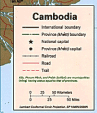
Border countries Thailand to the northwest, to the north Laos and to the east and southeast Vietnam
Stunning Angkor, the ruins of the centre of the glorious Khmer empire, are probably the kingdom of Cambodia's most well-known attractions. In addition, the country offers many more ruins, unspoilt beaches, hilltribes and volcanic landscapes.
Planned arrival May 2004
May 16, 2004 Northeastern Roundtrip
Educated Insights
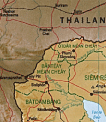
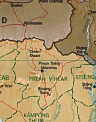
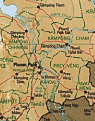
We had planned to take a slow boat up the Mekong from Kompong Cham. However, once there, we discovered that things have changed since the guidebook saw the light of the day. Only one express boat travels upstream to Kratie and further on to Stung Treng for a nice amount of money. In order to save our budget from starvation we decided to take a minibus for half of the journey. The minibus driver however decided to ask us for double the normal price. Christian was determined not to accept that and started to stop every passing car. Eventually he found Pom who came along with a World Bank funded 4x4 vehicle. He, however, was not going north to Kratie but east to Memot. It was seven o’clock in the morning, we are flexible, and immediately changed our plan. That turned out to be the best decision we could have made as this day became one of the most educating in Cambodia.
Pom works for the Ministry of Rural Development and he and his colleague were going to Memot district to inspect some rural roadwork.
The dark red soil in this area is very fertile and we passed cashew and pepper farms and many rubber plantations, sometimes trees with cups on the stem were lined up as far as the eye could see. Once we had turned off the newly paved main road, red earth covered the street. The villages consist of wooden stilt houses, steep wooden or cement stairways leading up to the entrance, some have intricate woodcarving on the middle of the ridging and on the gables. Hammocks are hanging or beds standing underneath, bare-breasted women are nursing their young ones, the other children are playing games that do not need any or only naturally available utensils, pigs and water buffalo stroll around, a wooden ox- or horse-cart is in the backyard, pepper or corn drying on mats or cut open rice sacks out front, all surrounded by palm trees. Absolutely idyllic and something we would not have seen on public transport.
Pom was pleased with the improvements that had been put in place on the first road. That one is only used by locals, their mopeds and ox-carts. The second road, however, which sole purpose in the planning phase had been to provide locals with access to the rest of the world has become a major trade route between Cambodia and Vietnam. Big trucks are now using a rural dirt road that was meant for motorbikes and ox-carts. Hence, the road is being badly damaged, poles that were to keep heavy traffic off the road are being pulled out and several offices within the Department of Interior (Customs, Police, and Military) have set up check posts to collect money. That money is not spent to enhance or just repair the road. The community’s checkpoint which does collect money for the up keeping of the road is largely overseen by businessmen as the community does not have any power to threaten them. Pom is very upset about the situation but cannot do much about it. What they had overseen in their plans for the road was the fact that a lot of cassava is being harvested on the Cambodian side of the border but that there is no processing plant. The next processing plant on the Vietnamese side is not far away and is now gladly sending it’s lorries over.
We listened to the troubles of a very well educated Cambodian official talking about the grievances in his country. He talked about the fights between the different ministries of which Cambodia has 24 (!), about corruption, the widening gap between rich and poor and his family which cannot understand that he is still not married at the age of 29. We could have returned with him to Kompong Cham that evening but while waiting for our lunch for an hour at Memot, where the second restaurant in town was closed due to wedding preparations, we met two employees of Chevron Texaco who were on their way from Phnom Penh to visit a client in Snuol, about 50km further east of Memot. The lady had just finished university and was in the second month of employment. The guy had been with Chevron for three years before which he had worked as a math’s teacher. He had decided to quit the job that he loved when his salary somewhere in the countryside was so low that he had to use $10 from his savings every month. This fitted in with something that Pom had told us: access to education is no longer such a problem but it is the quality of education that is a challenge. The good teachers do not stay teachers for long because they can make a much better living elsewhere. Something similar applies to policemen: on average they receive a salary of about $20 per month. Their quality of life depends on the post. The one at the newly vitalised border crossing to Vietnam has just bought himself a new motorbike…
Water, ice coffee and expensive adventure
The river journey on the roof of the express boat from Kratie to Stung Treng was long and rewarding. The Mekong is stunningly beautiful here, not resembling the lazy backwater we had experienced in northern Laos. The boat often had to zigzag in order to safely ship around rapids, low water or islands. According to a survey conducted by some Australians, about 100 Irrawaddy dolphins survive in this stretch of the Mekong, some of the last remaining fresh water dolphins in the world. We did not see any but they were probably watching us carefully. Instead we saw hundreds and hundreds of cormorants, pairs of colourful kingfishers, flocks of geese and the solitary heron here and there.
After catching up with other tourists on the boat from Kratie to Stung Treng, we opted for something that is not in the guide books. A friendly Cambodian restaurant owner who has lived in Paris for more than twelve years helped us to locate a boat heading up the Tonle Kong River to Siem Pang. Together with several locals, we boarded one of two small vessels going up the river that day. Sheer coincidence had it that two French Canadians embarked the other boat.
This river is not as wide as the Mekong but has some pretty exciting rapids. At times we were slowly zigzagging forward through fast-moving water or manoeuvring over or between rocks in the river bed sometimes with just enough water under the keel. For the second stretch of the ten-hour journey, the boat could just float along as the river turned into a calm wide stream with small settlements on its banks. We were surprised by how many people do live out there as subsistence farmers.
Along the way the boat stopped here and there letting off other passengers in what appeared to us as simply dense green forest. After a full day on the boat, we arrived in Siem Pang and were astonished to be accommodated in a concrete guesthouse.
The four of us remained the only tourists for the next three days and spent our time walking along the main road, up and down the river, finding two more guesthouses and also several locals who speak English fluently. This way we also managed to meet Annette, a British lady who has been living in Siem Pang for three years and is working for a Christian organisation called Youth With A Mission (YWAM).
Sitting in a simple riverside restaurant, sipping ice coffee, we chatted about the pace of life in Siem Pang, challenges and difficulties of villages in the Siem Pang region and that it usually takes two to three days to reach Phnom Penh from here, if one is lucky.
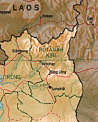
In the mornings we had noodle soup or freshly fried bananas for breakfast, strolled over the market, tried to harvest some mangos from one of the huge nearby trees, were more fortunate picking lime from the tree in the guesthouse’s grounds, played some basketball with a local and managed to rent bikes for an afternoon to explore the rural surroundings of Siem Pang. We had originally thought that we could go trekking in nearby Virachey National Park from here. However, even though there is a grand National Park office in Siem Pang, negotiations turned out to be difficult as there is no pricing policy in place yet for treks. At least we had seen some vultures and many other pretty birds on our bike tour.
So we lived the days away, experienced the genuine friendliness of the Cambodian people and their hospitality, got a good feeling for living in a small Cambodian village “out in the boonies”, listened to the first pour downs of the season at night and engaged in some chatter with the locals. Simply wonderful!
Moving on proved to be some sort of a problem or at least quite expensive, as we could either take the boat back to Stung Treng and a shared car to Ban Lung or rent motorbikes with drivers to take us through the forest on a more direct way east to Ban Lung. After fierce negotiating the drivers “won the battle” and we paid up to their price. The next morning we set off early to cross the river on a small ferry, made of planks tied over two wooden canoes. We continued on a muddy and pretty bumpy dirt track that took us, and all our gear, in about four hours across three rivers, through many puddles and some heart-stopping “almost fell” to Ban Lung. We had imagined riding through thick jungle but some major logging has thinned out that term. Nevertheless, it was a pretty exciting journey and to our surprise we were still able to sit afterwards.
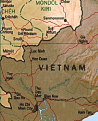
The dusty provincial capital of Ban Lung greeted us with a torrential downpour after we had just made it to a guesthouse. Within minutes, the driveway turned into a sea of red, every raindrop creating a little splash upwards as seen in films about bubbling lava. The width of Ban Lung’s streets suggests that somebody must have had big plans for the town. It does have an airport but not much else to offer. The best way to get around is on a moped which we rented the next day. Just seven kilometres out of town lies Boeng Yeak Lom, a volcanic crater lake situated amidst jungle sacred to the local minority people. We could not resist the serene beauty of the lake after all that dust and went for a swim. Rattanakiri province is Cambodia’s “wild east”, bordering Laos and Vietnam it is still one of the remotest places in the country, despite the airstrip in Ban Lung. Next time we visit, we hope that the National Park officials will have decided to welcome foreigners not only for their money but to actually show them the park where elephants and tigers are still said to roam.
The road from Ban Lung towards Stung Treng is not good but heading on towards Kratie it becomes an absolute disaster. Long, long time ago it was paved but the tar has broken up, leaving behind dangerous rocks in a sea of dirt and mud and holes. Where the original road has become impassable, drivers have created bypasses through the trees on the sides. Again we travelled together with the two Canadians and were all glad that we had opted for the much more expensive option of renting a taxi for the four of us. Normally, six passengers plus the driver squeeze into this old Toyota Camry or as many passengers as can fit sit on the back of a pickup for this voyage. It was obvious that our driver did not own his car as we hit the road very hard many times. He did drive well but way too fast for this calamity. A road is bad if you start hanging on to the hand grips at 20km an hour fearing for your life.
Seven and a half hours later we were all happy to reach Kratie alive and knowing that we had found one of those Cambodian roads that everybody is talking about but which are disappearing very fast nowadays.