Laos Itinerary
 |
 |
 |
 |
 |
 |
 |
 |
 |
 |
 |
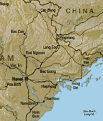
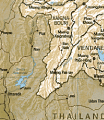
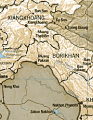
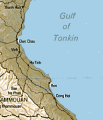
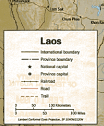
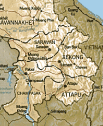
Location landlocked in Southeastern Asia, northeast of Thailand and west of Vietnam
Population about 5.7 million; approx 24 inhabitants/km²
Life expectancy 54.3 years
Area comparative about the size of Great Britain or slightly larger than Utah
Border countries to the north China, Vietnam to the east, Cambodia to the south, Thailand to the west and Myanmar (Burma) to the northwest
Laos, 'land of a million elephants' and one of the last places to see old Indochina. The pace of Laos is slow, its people are relaxed and extremely friendly.
Planned arrival March 2004
March 30, 2004, Laos Highlights Dust, air-con and walkie-talkies The organiser (www.panorama-inter.com) described the participants as managers and their families who are bored of flying First Class and would like to experience some real adventure, i.e. getting their 4x4 dirty on a Lao back road. Panorama takes care of the entire organisation; caravan participants can work until the last minute, drop their pen, get into their car, join the caravan and stop worrying about anything (even oncoming traffic, children and elephants are frequently announced via the walkie-talkie). Virat Tangkamolsuk was so kind to invite us into his car. He is a Thai businessman, fluent in English, who regularly joins Panorama on their tours through Southeast-Asia. Should you ever have to equip a professional kitchen in Thailand, his company (www.sevenfive.net) is your best bet. Besides learning much about his business and his retirement plans, we could ask him all of the questions about Thai society and food that had accumulated in our heads. We also learned that Thai has a polite expression for stopping for a toilet break: The men go rabbit hunting and the women pick flowers. We ended up spending two days with the caravan because Virat invited us to join in on the next day’s sightseeing programme in and around Luang Prabang. That way we got to see a nearby whisky producing village, a weaving village and drive a very scenic dusty road along the banks of the Nam Ou River which we would not have been able to get to otherwise. Huckleberry Finn, capsized boats and a bikini lady After the surge of adrenaline had evenly spread throughout our bodies, our thoughts were with our passports and the digital camera. Ever since, the passports, which Anja always carries along in her trousers, have their own zip lock bag. It turned out that the surrounding water was not very deep but do you know this while your boat is capsizing? Watching Panorama’s organiser deal with the situation was another thing: At first he almost suffered a heart attack, then he knocked back two cans of beer and to make the most of the situation started cheering up the crowd by dancing and singing suitable songs. After all, these guys had come for some adventure and will remember this one! Less weight enabled the helping hands to free the boat eventually and we all made it back safely a bit after sunset. The two-day journey from Luang Prabang to Pakbeng and further on to Houayxai on the Mekong was an atmospheric and tranquil adventure. The river’s might is currently tamed by very little water stretched over the wide riverbed. Like everywhere in Laos, the current season for slashing and burning the fields and the resulting hazy skies kept us from admiring the probably awesome surrounding landscape. Christian filled a gap in his education by reading about Jim and Huckleberry Finn’s voyage down the Mississippi while Anja watched people trying to make a living by fishing with nets and bow nets, washing for gold and transporting cargo. The Mekong is the people’s lifeline providing fish, river weed and snails to eat, water to wash clothes and cutlery, to clean themselves and for their animals, mainly the domesticated water buffalos, and a transport channel in a country where many towns cannot be reached by road. The Nam Ou River in Laos’ North offered a bit more excitement. We were very lucky because torrential downpours the night before had cleared the skies off smoke and we were actually able to see the spectacular mountain scenery! Our boatman seemed to know the river very well and manoeuvred us safely through some pretty good rapids. We just got wet every now and then. This time another boat had been unlucky and really capsized. Its cargo - people, bags, huge piles of raw material for grass roofs and chickens - had all taken a bath. Some of the chickens were the unluckiest because they had been rescued a bit too late and had drowned. Their price was fiercely debated after most of the water had been emptied out of the boat with every kind of bucket available. On the river everybody seems to help each other as all passing boats stopped to lend a hand. We did not understand much of the Lao spoken but understood that it had been some kind of accident between two boats - one of the boatmen must have ignored some traffic rule. An army officer, judging by his clothes, who seemed to have been a passenger on one of the many boats recorded the whole incident and listed all losses in a small notebook. We ended up taking in two survivors plus the dead and alive chickens. They debarked at Meuang Ngoi, a small village about an hour upstream from Nong Khiaw where we got off. Our travel guide describes Meuang Ngoi as Laos’ second Vang Viang. The dropping jaws and popping eyeballs of our fellow Lao passengers when seeing a pale English girl hopping around in her tiny bikini made us immediately understand. In Laos, where women always wear a sarong, a loose garment made of a long strip of cloth wrapped around the body as a dress, when washing or bathing this lady was stretching the cultural divide and the Laos’ patience with foreigners. We did not meet any of these tourists in Africa but Asia seems to draw crowds of marihuana and fun hungry Westerners. Can you eat? A poster had motivated us to stop in Vieng Poukha, a small town with one restaurant with a menu and two guesthouses that had not been open long. The poster promised a new trekking project, which was too young to be in any of the guidebooks. Hence, very few tourists know about it or dare to make the trip. The European Union is financing the effort to set up trekking trips in order to attract tourists to this area to provide an alternative income for the people of Vieng Poukha and the visited hill tribe villages. The guides who have started their training in October 2003 and have only been studying English for a very short time, were excited to see us. We opted to leave for the overnight trek the next morning and agreed to lead the guides’ English class that evening. We had noticed that none of them was answering the phone and so we had great telephone conversation role-plays, us pretending to be tourists and them trying to answer our questions. Some of them were extremely eager to learn and we all had a lot of fun. Maybe Anja should become a teacher after all? More than half a day on a songtheaw and two hours of English/Lao/sign language had exhausted us. The party that had been going at our guesthouse for a few hours already managed to keep us awake a bit longer. There are two things that inevitably make a Lao spill his/her guts: Either plenty of lao-lao, a clear but sturdy sticky-rice wine, or a long bus ride. Some of the guests at the party probably had too much of both that day and kept on decorating the lawn… The trekking trip was very interesting and enjoyable. We spent the first day stopping again and again in order to look up words in the guides’ dictionary. They separated the forest into edible and non-edible but medicinally usable or poisonous for us and we tried to explain in words and with drawings why on earth we do not have any children yet at our age. We have given up explaining that we are not married, it is just too difficult! The guides laid out a wonderful lunch for us on banana leaves close to a cave under the canopy of trees. There we feasted on bamboo shoots, cabbage salad, bananas and soft and sweet rice-coconut servings. The dinner was equally tasty. We had been wondering why the guides did not want to leave before 9am the next morning but understood when they started early to prepare sticky rice and to slaughter a chicken in our hut - for breakfast. All the cooking just took time and it was much the same as what we had eaten for dinner. The whole breakfast preparation made us realise how authentic this trekking project is. It also made us wonder how far a project should amend people’s habits in order to suit tourists. We happily accepted bananas for breakfast and were pretty sure that most other Westerners would do the same. It was extremely difficult to make the guides understand (and we are not sure whether we succeeded) that the food is tasty but we were already stuffed from the bananas and were not too keen on eating cabbage in the morning. Try explaining this to someone for whom "can" and "want" have the same meaning... We made another cultural observation when showing some postcards from Hamburg to our guide. He flipped through the ones featuring the harbour, old storage houses and the water fountain on the city lake. Seeing a group of white swans parading on one of the city’s canals immediately prompted one question which we should have been prepared for: "Can you eat?" Imagine our answer: "Yes, we can but we do not want to." Puzzled faces all around us... Visiting the hill tribes and staying overnight in one of their villages was also part of the trip. However, we had to discover that we are just not made for "people staring at other people and vice versa tourism." It was good to note, however, that there are things that can divert the locals’ attention from us: porcelain toilet units arriving on the bed of a battered truck. We are not sure whether visiting foreigners are really a good thing for the hill tribes. Yes, they will probably be overrun by globalisation at some stage anyway but is this the way to prepare them for it? Maybe this whole business was also started because the Asian animals are extremely tricky to spot respectively hide far away from any civilisation? Anyway, we have given up on our pursuit to see a tiger after learning that scientists often only know about the existence of the creature from tracks, droppings and snapshots taken by trap cameras at night. History in the dark Five of them were opened officially to the public in 1998 but still very few tourists make the effort to come out here. That was much to our liking as we were the only tourists staying overnight in the town. The only other foreigner was a Canadian volunteer accompanied by her Lao colleagues. We hooked up for the guided cave tour, which turned out to be vital as the guide was only able to point out the most obvious sights in English. After the Indochina War, the caves were used as re-education camps for officials, soldiers, intellectuals and the royal family. Our guide did not mention a word of this part of history... It was pretty impressive to imagine that not only single people but also whole villages actually lived in the caves for several years. Apparently, the caves became home to 25,000 people, with caverns serving as schools and factories, sports areas and hospitals. The senior leaders each had their own private cave, with living quarters, meeting rooms and an airtight emergency chamber in case of gas attacks. The five caves that are currently open belonged to these leaders. One of them, a huge natural tube-like grotto, features a large assembly hall with concrete flooring nowadays popular for wedding parties. Sadly, it was too dark to take any decent pictures. Vieng Xay will surely become more popular with tourists once the border with Vietnam opens up. For us Vieng Xay was worth the painful and long bus rides through beautiful scenery because we enjoyed being off the beaten track. We have asked Nalee, the girl at Xam Nua’s bus station who is probably the only person who speaks English well in that town, to let us know when the border opens. Then there will definitely be potential for another guesthouse in Vieng Xay! Luang Prabang - World Heritage anew Only about a dozen streets make up the old part of town and they are lined with small shops, temples, and houses, the buildings a blend of local and colonial era architecture. The town looks better at night when the indirect lights hide the signs of use on the houses and conceal the newness of the red brick alleyways illuminated with brand new pottery lanterns. The latter are no doubt charming but do not really match our perception of world heritage. We always envisaged something old with this term. The title might however do much to preserve what is still there and help to keep new concrete style houses out. We thoroughly enjoyed the freshly mixed fruit shakes, both the Lao and Indian food on offer, and our many strolls over the nightly souvenir market. The textiles on offer have been adapted to Westerners’ tastes but are nevertheless beautiful and incredibly cheap. It is also an impressive sight at the break of dawn to watch the Buddhist monks from all the town’s temples walking the streets dressed in their orange attire, elders first, youngest novices last, receiving their alms from the population. Another highlight was our planned meeting with Caro and Daphne, two of Christian’s fellow students, who have been travelling South Africa, Australia, New Zealand and Southeast Asia for the last five months and will return back home this week. We dined together and went on another boat trip on the Mekong, visiting a pottery village, a place where paper lanterns are produced from mulberry paper and the Pak Ou caves, a depository for hundreds and hundreds of damaged Buddha statues and amulets. Before tourists came to see them, the caves were forgotten for most of the year except for Lao New Year when local residents make the 25km boat trip up the Mekong in order to earn merit by ceremonially washing the Buddha images. Caro and Daphne are earning merit from us by returning our Lao guidebook and our nice but not required camping mugs to Europe! We are now back in Vientiane where writing this update was much cheaper than elsewhere in Laos and from where we will board a Lao Aviation plane on Thursday, 1st of April, that should take us straight to Hanoi.
We had hoped for this to happen since Madagascar. In Vang Viang, surely once a nice little town before the backpackers rushed in and requested Happy Pizza, the thing you know plus pieces of dope, our time had finally come: We were courageous enough to ask the self-driving overland caravan of luxurious 4x4s whether we could get a ride to Luang Prabang. We had already seen them rushing past us in Vientiane, eighteen nice numbered cars full with advertising stickers. Envisage the whole thing as a few private cars driven by their owners but everything around the cars is an organised holiday package tour. You (your car) get a number and you have to stay at this position of the convoy throughout the trip. This is where we caught them in Vang Viang as it always takes some time in the mornings to get everybody in line.
It is almost impossible to travel Laos without hopping onto a boat now and then. We have tested several slow boats by now, leaving the noisy and dangerous speedboats to braver and deaf souls. Nevertheless, our first slow boat adventure, a sunset cruise at Luang Prabang with the Thai caravan drivers, almost ended disastrously when the boatman hit a sandbank at full speed and for a split of a second it looked like we were turning over. The weight of the people, whose survival instinct forced them to quickly move to the upper side of the boat, was enough to stabilise the tub. Most women and children, some of them could not swim, were evacuated by smaller boats that rushed to the rescue.
Our adventure in Vieng Poukha started and ended with the road there and away. It came in second only to a 20km stretch of road close to Xam Nua in the Northeast, which was truly disastrous. This one was just a bad dusty road through a very mountainous region with many little streams. We admired the bus driver who managed to manoeuvre his 40-seater around the hairpin curves and through the riverbeds (see pictures in gallery).
Vieng Xay is about as close to Vietnam’s border as a tourist can currently get in Northeast Laos. The border crossings up here are only open to Lao and Vietnamese but are closed for third country nationals. Nevertheless, all guidebooks announce that this is to change soon, even ours from 2002. Vieng Xay, the City of Victory, was the Pathet Lao’s hiding place during the US’ secret war in Laos. The political leadership used the cave riddled limestone karsts that surround the village to escape the extremely heavy US bombing. There are hundreds of big and small caves some reachable from the bottom some only via ladders high up on the karsts.
The charm of this city and its big nightly textile market made us visit Luang Prabang twice. Luang Prabang is the old capital city of the Lane Xang Kingdom and dubbed the Jewel of Indochina. The location of the old part of town on a peninsula hugged by the Mekong and the Nam Khan rivers and surrounded by mountains is prime.