Vietnam Itinerary
 |
 |
 |
 |
 |
 |
 |
|
 |
 |
|
|
 |
|
||
 |
 |
|
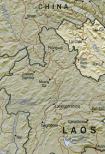
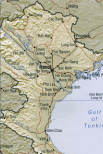
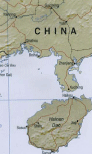
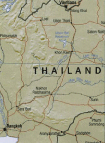
Location Southeastern Asia, bordering the Gulf of Thailand, Gulf of Tonkin, and the South China Sea
Population 80.3 million; approx. 250 inhabitants/km²
Life expectancy 70.05 years
Area comparative about the size of reunified Germany or slightly larger than New Mexico
Border countries Vietnam stretches to the east alongside China, Laos and Cambodia
Once a country associated with war, Vietnam is in reality a country filled with captivating natural beauty and tranquil village life.
Planned arrival April 2004
May 02, 2004 Vietnam Observations
Uncle Ho and his people
We thought we had outsmarted all of the others by being at the security check post for Ho Chi Minh’s mausoleum shortly before opening time at 7.30am. We felt assured when no other visitors had turned up until 7.32am. Then, we woke up: Suddenly hundreds of Vietnamese appeared from the left about fifty metres behind the security post. Neatly marching in rows of two they must have entered through another entrance, not open to foreigners. We watched in astonishment the line of people slowly but continuously creeping forward until we recovered and demanded admission. Once enqueued, security forces made sure that there was no stepping out of line, no overtaking, and no stopping. We trotted along the parade ground in front of the mausoleum, started shivering (it is freezing cold!) once we entered the building on the left, walked up a ramp and entered his room. The fracture of the minute that it was our turn to pass Uncle Ho’s embalmed body at due distance from head to toe then around his toes and back to his head, we could see for ourselves that the orange light and the cold do seem to keep him as fresh as ever in his glass sarcophagus. Well, he should look good as he spends two months a year in Russia undergoing maintenance work.
Ho Chi Minh’s image would follow us throughout Vietnam. Although he died in 1969, Uncle Ho is still omnipresent in pictures, bank notes, posters, official paintings, busts and old men who imitate his looks. The only image outnumbering Uncle Ho is Vietnam’s national flag, red with a big yellow star. One has to try very hard to find a place where there is no flag in sight.
The mausoleum was probably the only place in Vietnam where we experienced such calmness and orderliness. Elsewhere, they like it loud, very loud. Whether it is music, TV, vehicles out on the streets or yelling after us, volume is important. And no matter how small a shack, you will always hear the TV.
Vietnam has developed a distinguishingly different traffic system from its neighbouring countries. Nobody uses signals when turning and very few people slow down or dare a look when approaching junctions, red traffic lights or other obstacles. You simply honk your horn. You also honk the horn when you see there is no immediate danger in sight but think that one could develop out of the blue. Hanoi with its thousands of scooters, motorcycles and bicycles is especially noisy and finding a guesthouse somewhere in an alleyway far away from the bigger streets is a necessity if you want to sleep at night. Sometimes we thought that the honkers wanted to keep bicycle riders and pedestrians from developing any suicidal ideas.
After all, Vietnam presented quite a challenge after laidback and peaceful Laos. To be fair, we have not forgotten the Lao people’s fondness of Lao Karaoke music.
The Vietnamese want to prosper and are economically focused. Unfortunately, this also means that many of them try their luck by asking foreigners for inflated prices. Anja had one of the hardest discussions at 5.30am with some old ladies at the ferry pier in Cat Ba town about the price of small baguettes. We knew the normal price and during the discussion many Vietnamese were buying bread for that price but the ladies still insisted that we had to pay double that price. Finally, competition worked in our favour and one of the ladies decided that it was better to make some money on us than none. Not the prices made us argue but the principle. Many foreigners must think that the place is such a bargain that they should pay a little extra. People have grown accustomed to it and just ask for more right away. We do not feel like moneybags and keep on arguing. At least Vietnam Railways now has standardised fares for all human beings.
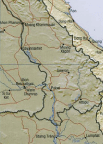
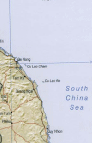
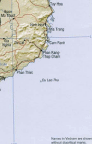
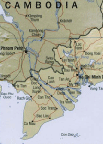
Nevertheless, room prices are great value and often negotiable under the set price. We have not stayed in so many nice places since we hit the road in July. In Vietnam, ensuite rooms with TV are standard and at times we made the amount of TV channels available decide about where we stayed. And although the locals are so much shorter, beds in Asia are long enough for us. The Vietnamese made no secret out of the fact that they were fascinated by our height. Anja regularly had men queuing up in order to see which part of her body was on par with their shoulders. Whereas this was always good for a laugh, the Vietnamese Kindergarten-size plastic stool-only eating establishments often made us eat up faster simply because our backsides could not remain squeezed in a minute longer or because our feet or knees were numb. We usually revitalised them by walking wherever we could, not to the liking of eager moped-taxi and cyclo drivers who always offered their services. Vietnam probably qualifies as the country where we have used the greatest number of means to move around. We flew into Hanoi, took a local bus into town, strolled the city, got on a local train east to Haiphong, embarked on a big old ferry across to Cat Ba Island, rented a moped to discover the island, returned by ferry and had two moped-taxis take us and our bags to a minibus back to Hanoi, boarded the night train to Hue, cycled the surrounding countryside, took the hop on hop off tourist bus from Hue to Hoi An, slept in it from Hoi An to Nha Trang and used it again between Nha Trang and Saigon. From there on local busses, moped-taxis, cyclos and small ferries manoeuvred us through the Mekong Delta and a hydrofoil was supposed to take us from Rach Gia out to Phu Quoc Island. Unfortunately, "Superdong", Dong being the national currency this probably means money machine, only made it twenty minutes out of the harbour when something went wrong and all passengers were transferred to "Seabird", on sea.
That boat delivered us safely to the island where we relaxed for a week at the beach, reading and snorkelling the day away. Sadly, what we would have liked to see in the water, for instance corals, was being sold outside in great quantities. On the other hand, the northern part of the island has not yet suffered from any slash and burn agriculture and remains under thick green forest cover.
Vietnam's climate made us put on all of our clothes in the north and sweat much in the south. It also enabled us to imagine how green Laos must be during the rainy season. Between Hanoi and the Mekong Delta we saw field after field of endless green rice paddies. Some Vietnamese seem to choose to be buried in their fields and the bright white tombs slightly upraised from the surrounding green paddies actually look very pretty.
We could not make out whether there is a regulation with regard to burying people. It seems as if one can be buried anywhere even in the front yard. There are also some sites that we assumed to be cemeteries just because there were several tombs scattered around one hill. Only the many, many graveyards for soldiers, reminders of the infamous war, are painstakingly and somehow depressingly ordered row after row and stone next to stone.
Seeing this and having learned that between 1965 and 1973 US B-52 bombers dropped eight million tons of bombs on Vietnam, three times the amount of bombs dropped on both theatres throughout the whole of the Second World War, working out at approximately 300 tons for every man, woman and child living in the country, Vietnam has recovered astonishingly well and the human spirit has prevailed.